Reel Talk: Brett Nichols

[ad_1]

If you ask Brett Nichols a question, you often get a minor dissertation back. It becomes quite clear that he’s put the utmost thought into every decision he’s made that day, and probably every one he expects to make over the next six months too. That obsessively contemplative personality is very apparent in his video Pathways, where a vast and deliberate collection of spots, skaters, and imagery never strays from its theme. Read on to dive into his extensive thought process behind this exciting video.—Alex Aho

Chris Jatoft, drop in. Photo / Nichols

Chris Jatoft, drop in. PHOTO / Nichols

Interview by Alex Aho

There’s a specific theme to this video. How would you describe it?
I feel like there’s a story to tell. I’ve been collecting skateboard videos my entire life. I’ve always had a huge focus on trying to find independent and international videos. I think my collection right now is up to about 1,500 videos or so. One of the scenes that has influenced and inspired me the most has been the Japanese skateboarding scene. I had a friend that ran a skate shop in Japan living in San Francisco, Hidehiko Fujiwara, and he would bring me videos back from his trips.
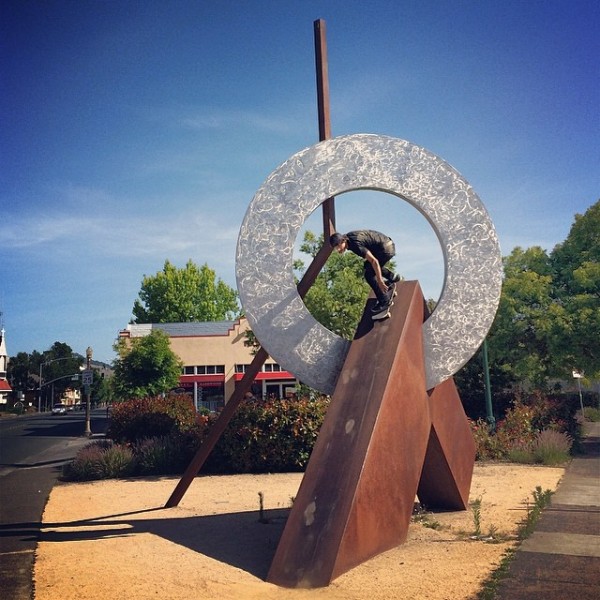
And then, February 11, 2011, I saw Minuit, Yoan Taillandier’s video, and it made something click. I’m like, “I can actually do this where I live. There are a lot of spots that look like this, and if I just filmed at those spots, then I could make something look like a Japanese video.” I started that day. I tried to take my own approach, really focusing in on modern architecture, just because that’s what always interested me the most in Japanese skateboarding videos—that the scenery looked so different than where I lived, and in some ways, dreamlike. I tried to focus in on a video where we’re skating all spots that are modern in their surroundings—sculptures and all those sorts of things.

What are some videos that influenced you?
Outside of Japan, definitely always saw some interest in all the Magenta videos, all the Antiz videos, Skylarking and Forays by Daniel Kircher—you could tell he was looking to capture as much interesting imagery within the city as he could, and really show what his surroundings look like, while only capturing the best elements of his surroundings.
For Japanese videos, Journey by Skate Atom with Deshi’s part. That was one of the coolest things I’ve seen in a long time. That video really shows how that guy seeks out the most awkward transition spots he can possibly find. Everything that the Far East Skate Network has done, Dialogue Between Insiders and Lenz I and II by Tightbooth. Skate Archives, This Continued, and Snap to Life by BP Trading. I’d say BP Trading might be one of the bigger ones just because they were always focused in on finding random transition spots. It wasn’t always about skating in the city center. You could tell watching Skate Archives that they were going out to rural areas looking for awkward sculptures and playground structures and all this kind of weird architecture. In Japan, their concrete playground structures basically look like skate parks.

Trevor Murphy, roll-in grind. PHOTO / Nichols

Trevor Murphy, roll-in grind in an old concrete playground. PHOTO / Nichols

Built by Robert Winston for the California Garden Show in 1952. Here are original photos of the spot.

Built by Robert Winston for the California Garden Show in 1952. Here are original photos of the spot.

As you’re talking about these guys finding awkward street spots, would you say you found a parallel by doing that? In the Bay Area, there aren’t quite as many concrete waves and light structures and things like that, but do you think that when we watch Japanese videos, we think, “Man, these guys have spots every ten feet,” but are they doing the same thing you were? Digging?
That’s a great question. I haven’t been to Japan, so I don’t know. But I have a number of Japanese videos where they are not really skating spots like that, and then there are videos where it’s end-to-end filled with spot porn. I think some of those guys have to dig pretty far to find the stuff they’re skating. I had to take the same approach in some ways. Certainly, there are spots like this in downtown San Francisco, downtown Oakland, but a lot of spots I found were a two-hour drive into the middle of nowhere, and there was just one crazy looking sculpture out there. The way I was finding some of this stuff was looking at modern architecture blogs, looking at websites dedicated to sculptures, doing a Google search with certain keywords—I’d rather not share which keywords so as not to blow up my spots—and add city names to the end. I would spend hours and hours looking online for stuff.

The internet is where you found a lot of the spots then?
I spend tens of hours a month looking for spots on my bike, which is how I found most of them, but I would say I found some of the best spots on the internet. One thing I’ll point out in particular, and I brought it up earlier, is about Japanese concrete playgrounds. They have all these concrete playground structures that are really unique. They look similar to skate park obstacles, and I wanted to find stuff like that because those spots always sparked me. If you search for them online, eventually stuff starts popping up.
One thing about those types of structures is a lot of them were really unsafe. There’s one, for instance, in the East Bay, around where I live, that’s basically a concrete playground city built into the side of a mountain that has 10-12 foot drops out of nowhere with no guardrail. Since they were built probably in the early 70s, a lot of these places have been torn down, so you really have to go out there and search for them. And by searching for them, I mean you have to scour the internet for them. And they pop up. They’re just really tucked away.
The real dilemma with skating those spots is that you have to wake up really early in the morning and try to get there around 7:30-8:00 a.m. before kids show up.

So, are you Googling “Empty playgrounds that parents might not be at” and picking up some NSA followers?
[Laughs] I’ve already considered that. That is a potential side effect. But it’s been a fun process to try to convince my friends that they need to wake up at 7:00 in the morning to skate some odd concrete slide, or whatever.

Would you say when you were searching for spots that it was pretty much you and it wasn’t really the skaters in it?
That’s something I forgot to touch on. Another great thing I had going for me in searching for spots was that a lot of skaters knew what I was trying to do, because I was filming with so many different people that I would randomly get photos of spots texted to me, and I’d be like, “Oh, my god. That’s amazing!” Actually, there was one day where two people texted me a picture of the same sculpture. But I don’t think people were scouring for me. I think it was more that they were walking around in their day-to-day surroundings and they would find something that they thought would fit. I definitely tapped into the help of friends.

Jake Chavarria, boneless. PHOTO / Nichols

Jake Chavarria, boneless. PHOTO / Nichols

How long did this video take?
Five years. February 2011 to right now, and I’m pretty much done right now. It took five whole years.

So what happened?
The real dilemma came in many forms. First would be security. When we’re skating some nice modern architecture, there’s often someone there who doesn’t want you to skate it. So that took a lot of persistence. I’d say some tricks took us about 20 trips to make it happen before getting kicked out.
A lot of it is just how much I work. I think when I first started the video, I was working six days a week. And over the last four years, I’ve been working at a startup, so I’m working sometimes 12-15 hour days. I had to edit the video in piecemeal. Some days I’m editing 5, 10, 15, 20 minutes at a time. When I was lucky, I would get to edit for an hour at a time. So the entire video was pieced together slowly over two years because I had to find the time to squeeze it in.
And also, you can only hit so many of these spots in one day because they’re spread so far out. Some people were just in on the idea right away, some people—it’s a little tough to ask someone, “Hey, do you want to drive an hour away to go check out this one thing?” and then you’re immediately kicked out.

I think one thing worth noting as far as time goes, you get pretty intricate with your editing here. There’s a lot of Super 8; there are a lot of quick cuts.
Sure, and I can even speak on that. Going along with following what the Japanese are doing—people like Shinpei Ueno and Takahiro Morita from the Far East Skate Network—those guys are really focused on creating unique imagery that lends to the idea of dreamy otherworldliness—to have spots that don’t really look like something that’s in your regular surroundings, and then to have imagery to go with that.
A lot of the way that I found that was also searching for interesting urban art—mostly moving art—there’s a hinge, or wind moves the sculpture—and shoot that in a time lapse. I spent a lot of time going to science and art and architecture museums that have interesting experiments that might have some moving parts and shooting those.

Chris Jatoft, fakie thruster. PHOTO / Nichols

Chris Jatoft, fakie thruster. PHOTO / Nichols

So a lot of these things that you’re filming aren’t even necessarily things you find at spots, but just things you thought were relevant to the theme as a whole?
Yeah, just trying to create an otherworldly feeling. And I’ll say maybe about 60-percent to 70-percent of the video is all VX. The rest is shot on a Super 8. I think that the look of Super 8 lends to that dreamy feeling. And there were definitely a number of influences there. I would say when I saw—and this was a lot later in the process of making the video—I saw Cuatro Sueños Pequeños by Thomas Campbell, which was actually about dreaming! I’d already shot quite a bit of Super 8 at that point, but it definitely sparked me to move further in that direction.
Another influence was Josh Stewart. Static might be my favorite video series. I’d say Static III mostly, because he really captured a very defined look and feel, and he really stuck to his guns.

A lot of building porn in that one.
Exactly. It’s one thing to make a film that’s filled with good spots and good skating, but to make something that really tries to follow a theme, it’s a real challenge, because you have to get people that are on board with understanding that even though that spot is really good, and if you were to do that trick it would be really good, it doesn’t exactly fit the theme that I’m going for. I’d say Static III was one of the first videos I saw that was really tied into a theme.

On that note, being that there is a specific theme for this video that got people rallied around to find these kinds of spots, I wouldn’t say anybody in this video is only skating the kinds of spots that are in this video, so how were you able to separate the way people skate on an everyday basis compared to this?
I had a lot of people that wanted to work on other projects at the same time, and I knew what I was doing was really niche and not always easy. I helped people film for their own projects at the same time as a way to give back for their participation. Chris Jatoft has a really good video part that’s coming out around the same time as Pathways. I helped him edit that as well. So look out for that.
I understood that I was trying to convince people to do things they often didn’t want to do, and I definitely brought people to spots where all I got were puzzled looks and, “What the hell are you thinking?” It definitely took the right types of skaters.

Alex O'Donahoe, nose manual. PHOTO / Nichols

Alex O’Donahoe, nose manual. PHOTO / Nichols

On that theme, in the four or five years it took to make this video, Magenta started doing those styles of videos, and even Japanese videos got a little bit more American presence during that time, so did you run into a lot of NBDs that became ABDs or any other competition?
When I sought out to make this video, I was hoping to have all original, untouched spots. And it’s pretty difficult to do that when some of your spots are in downtown San Francisco [laughs]. Minuit put my head in a certain place, but a lot of people have sort of moved in the same direction, which is great; skating is more interesting, and I think Yoan and Japanese videos are responsible for a lot of that.
And skateboarding moves so fast now that there’s just no avoiding it. To me, I’m making this for myself. I’m making the “Japanese” video that I always wanted to see, focused in on modern architecture, sculptures, all those things.

Is this your first video?
Yeah. I’ve been skating since 1993 and filming since probably ’97 or so. I always filmed for fun. I would ask a friend to film me and then I would film him. I would usually just give the skater the footage and that was it. I had a part in a video released by Studio411 in 2007 called Calligraphy as well as some other stuff here and there. It was always a creative outlet. After a number of knee injuries, it got to the point where it wasn’t a very functional creative outlet for me and I needed to do something different. I wanted to get behind the camera and actually put a film together.

That’s an interesting point you brought up about how you film for fun. A lot of people equate filming with sponsorship, or the jocky aspect of skating, where that’s not the case for you at all. Not just you, but this whole wave of indie videos, where you see 30-35 year old dudes filming like they did when they were 16 just because they’re excited to do a project.
Well, I’m 30 years old now [laughs]. I think I gave up on the skateboarding superstar dream when I was about 16 years old. I was in one of those 16 Below videos Sole Technology released in the early 2000s, I blew out my knee, and then I thought, “Oh, things can happen in life that prevent you from being an athlete.” I realized that it was not for me at a good age. I always wanted to go to school and I always had interests outside of skating.
I’ve always loved skateboarding and I’ve always loved it from a creative perspective, and as much as I love going out and skating for fun and going to skateparks, I’m not building something creative. And that’s why all those years after, I was always wanting to do video parts, just because I felt like I was creating something for myself that I could look back on and enjoy, since I’m now at a point where doing that doesn’t work as well as it used to. To be frank, I have to warm up to flatground ollie now. I still occasionally go out and get a trick. I’ve got footage in Pathways and I’m working on a new project that I’ve already filmed tricks for, but it makes more sense for me to be the one behind the camera.

Chris Jatoft, powerslide. PHOTO / Nichols

Chris Jatoft, powerslide. PHOTO / Nichols

What’s this new video you’re working on? Is it a similar themed project?
[Laughs] I’ve got three other projects in the works right now! I went to Berlin for ten days, and we—myself, Harry Hafner, Bobby Groves, and a bunch of locals—got more footage in ten days than I usually do in two months.
After that, I’m doing another video called Broadway. Again, I talked earlier about how different my video is to my actual surroundings. I’m trying to do a video that matches my surroundings of crusty, classic, and older architecture. I’ve lived in the East Bay for about the last eight years, and I’ve always told people how great it is on this side of the water. Everyone wants to see San Francisco. But the entire video is filmed outside of San Francisco, but in the Bay Area, so Oakland, Berkeley, Santa Rosa, Vallejo, all these other cities out here.
On top of that, I’m trying to do another project that’s like Pathways—another video exploring modern architecture. I’ve already got significant headway on all three.

No more five-year projects?
I’m hoping to put them out quicker. I think in the first project there was a lot of trial and error. There were also a few technical issues in there that I encountered, so it took me a lot longer than I expected. Now I have a better idea of what I’m trying to do and I think I can do the projects faster. I’m still going to be meticulous. I definitely want them to have a certain look and feel, and however long it takes to achieve that look and feel, that’s what I’ll do. I don’t want to put anything out until I feel like it’s something that makes me happy.

Follow Brett on IG: @brettenichols

Follow Alex on IG: @boogerparty

Chris Jatoft, boneless. PHOTO / Nichols

Chris Jatoft, boneless. PHOTO / Nichols

More Reel Talks:
Johnny Wilson
Jacob Harris
Peter Sidlauskas

[ad_2]

Source link

Substance Interviews

[ad_1]

How has your experience been filming this? I heard you were hurt for the first six months.
Yeah. I didn’t start skating until sometime in June. And then I broke a rib at the end of July and couldn’t skate for all of August. So I really got started on this in September.

Damn. What was the first injury again?
I broke my foot at the end of 2014. I had surgery on it, and it just healed super slowly. I had surgery December 1, 2014, and the doctor was like, “Oh, it can take anywhere from seven weeks to three months to recover.” Being a skater, of course I was just like, “Oh, I’ll be skating in seven weeks or sooner. Because we’re really tough, right?” [Laughs] But then I would keep talking to Thiessen like, “Yeah, all good. I just need one more checkup and I’ll be back next month. Every month I would basically end up telling him “one more month!”

Backside Tailslide Gap Out

Davis Torgerson, backside tailslide gap out. PHOTO / Chami (click to enlarge)

That must have been rough waiting to heal.
Oh, totally. I was like, “I am so excited to do this project.” Being stuck at home while the clock was sort of running was super frustrating. I was of officially in the video last December. I had had the surgery like two weeks earlier. At the time I was telling Chris like, “I’ll be good in a month!” After a while I started feeling kind of bad, like I might have blown it for him.

It might work to your advantage. Like you’ll be the guy who’s most charged at the end after waiting so long. How has it been since you got to skate finally?
It’s been good, but it’s tough too. Because mentally I’m really excited to skate. When you’ve been out for that long that’s all you want to do. But physically I’m trying to film a video part while I’m still getting my skating back to where it was before the injury.

Did you know the other guys prior?
I knew Tristan [T-Funk] from DC trips and then I had met Tom K a while back before. I hadn’t met Jon or Dolan before. Right when I got on board, I think Dolan was in and Tom was in, but the other spots were still open. Chris would keep updating me on who was potentially in it, so that was a cool process to find out who we would share the video with.

Are you a fan of the VX?
Personally I definitely am. I used to have a VX back in the day and film a lot. From the Boondoggle days in Minnesota, I was always the guy in the crew with the camera. I remember when Chris was telling me that TransWorld was down to do it all VX, I was stoked. I’m excited just for something different I guess.

It’s funny to think of the Ty Evans TransWorld mold and how it was always sort of considered the highest production value possible. This will definitely be different from that.
Totally. I think it’s sick. That’s one of the things that makes this project so special for me. In a time where there are no more videos, there’s no feel to anything. Everything is thrown together and diluted on the Internet. So to work towards something that will actually be in one whole video, with an actual premiere—the whole VX thing will make it blend and sync up that much more. Rather than just 50 different filmers with no feel or style. Not everyone is going to like it. Some people will love it, and other people will hate on it and talk shit on it.

Everybody is gonna love it.
[Laughs] Yeah. They are.

tom_karangelov_ollie_ollie

Tom Karangelov, ollie, ollie. PHOTO / Strand (click to enlarge)

People were saying you are sort of the tech dude in the bunch. Tom K and Dolan are more big basics. T-Funk is all over with fastplants and all that. Jon is sort of the Isle-style ow guy on some cobblestone or something. You’re like the Shane O’Neill of the bunch.
[Laughs] So weird. Yeah, it’s probably Jon and I doing the most flip tricks and switch stuff. But it’s funny because I’ve never thought of myself as the tech guy. That’s so far from what I am [laughs]. I like that skating is mixed up right now though. You can go from Grizzly Grip to the dude in the tucked-in Polo shirt.

All-time best TWS video part?
The first one I saw was maybe In Bloom [’02]. As a kid I was psyched on Evan Hernandez. He was sick. But honestly I think my favorite part might be Chad Tim Tim in A Time To Shine [’06]. “I stopped doing what I thought I should do and started doing what I wanted to do.”

Dolan Stearns

How has this process been for you? Good times?
It’s been really fun. It’s a whole new experience for me. I had never traveled this much. These were my first big overseas trips. China was insane. Just like a whole different world.

You guys went to some out-of-the-way destinations even for China.
Yeah. The first city we went to, Kunming, was really cool. You could still actually eat. Then the second city [Chongqing] was pretty brutal. Just massive culture shock and pollution.

Had you filmed with Thiessen prior?
I had filmed with him when Neen [Williams] had a part in Outliers. I met up with him for the weekend up in LA and just filmed some clips. That was the first time I met him, and then we stayed in contact. Then I got a call from him one day out of the blue hitting me up for the next video. I was just like, “I’m super down.”

Backside Nosebluntslide

Dolan Stearns, backside noseblunt-slide. PHOTO / Chami. (click to enlarge)

How was that call? Must have been a gnarly one to get.
Yeah. I was up in the hills above the lake picking sage to make sage bundles and stuff. I was looking over the lake when he called me. I was just like, “Life is awesome.”

Biblical moment.
Pretty much.

I was told at present you have the second most footage with like 12 minutes or something. Have you been on a roll?
Oh, fuck. That’s sick. I didn’t even know I had that much [laughs]. I don’t know. I just film. I like to skate. I know other people might be planning this all out or something, but I just skate. If I see something I want to try, I do it.

Thiessen was saying that one of his objectives with this was just to let it happen. Not pressure anyone or push for anything.
Yeah. I love Chris’ filming too. He’s such a good dude to go out with. He’s really motivating. He lets you do your thing.

dolan_stearns_kickflip

Dolan Stearns, kickflip. PHOTO / Strand. (click to enlarge)

How about the VX front? Are you down for that?
For sure. I fucking love VX. That’s skateboarding right there. HD is cool, but it’s a whole different vibe for skating. That’s like some football shit to me. VX is just our thing. It’s what we know. My uncle was a filmer out in the I.E. [Inland Empire, California], so I’ve been around the VX for a long time. His name is Matty B. He made the Janky video. He got my brother into skating, and then I got into it from there. But I also just love filming. It’s really fun. I love that ritual, and we did it while filming this—after you get done skating, you go back to the hotel and get a little rerun of what we got for the day.

This video feels like it will be a radical departure from the TWS formula. I know they’ve claimed it before, like Not Another TransWorld Video, but then it still felt like the same format. This one seems like it will actually be completely different.
Yeah. I think this will be one of the better ones out of all the recent ones. I hope so at least [laughs].

dolan_stearns_ollie

Dolan Stearns, ollie. PHOTO / Strand. (click to enlarge)

Thiessen told me about this China trip where you left your board at LAX then realized you had no other boards for the trip.
[Laughs] Yeah. I had eaten this little edible. We were in the line to get through security and I started to feel it. We were running late to get to the plane, but we still wanted to stop at the bar and get a double. I think I left my board at the TSA screening. I put my shoes on and just grabbed my bag on the way to the bar. I didn’t realize until I got off the plane in China, some 13 hours later that I had no boards at all. Tom hooked me up with some Thunders. I went to a shop, traded them for Indys, bought two boards and those lasted me the whole trip. Luckily I still had wheels and bearings and stuff.

Standard ender. All-time best TWS part?
Cardiel Sight Unseen [’01] and Brad Cromer in Outliers [’14].

All-time best TWS video?
Sight Unseen.

More from Substance

Cop a hard copy of Substance or download a digital copy from Vimeo!

Substance Jon Nguyen Interview

Substance Tristan Funkhouser Interview

Substance Espana

Substance China

Tristan Funkhouser Substance ‘Second Part’

Substance Alternative Angles 


[ad_2]

Source link

2016 Footwear Guide: Quick 10 W/ Chad Muska

[ad_1]

If you grew up skating in the 90’s or early 2000’s, then I’d bet a finger and a toe that you’ve heard of Chad Muska. I’d even bet that he might’ve influenced you a little bit. You might’ve even owned a pair of cargo pants with the zippers that turned into shorts, didn’t you? Or maybe a bright red or yellow 2XL tank top perhaps? You wore a crooked hat. You skated with a backpack on while holding parents broken boombox in your arms like an infant. Don’t deny it! Don’t be ashamed! We all did it. And we did it with pride. Chad Muska is one of skateboarding’s most influential characters, but his talent spans far beyond his skills on a skateboard. He’s an accomplished designer, an artist, a DJ, and, well, the list goes on. For our 2016 Footwear Guide presented by Skate Warehouse, we caught up with Chad to get the rundown on his current role at Supra, a few of his footwear preferences, and to see what’s in store for 2016.

MUSKA Footwear Guide

Crooked Grind, NYC. Photo: Trihn

What’s new for you and the Supra family?
Well, as a lot of you may have heard there has been some new corporate infrastructure changes that have happened recently for Supra and I just want to say that this does not really change our company at all from the outside looking in. We come from skateboarding and we will stay true to our roots as we continue to progress and grow into the future no matter where we call our office home. The skate team has been killing it on tours in Europe, America and in their own individual time. I have had a back injury that has taken me off the board for a while so I have just been creating and directing with the company as I always have, even when I was skating everyday.

So it sounds like you’re pretty involved with the ins and outs, yeah? Are you involved with the production process? What model are you most stoked on in the spring line?
In the past I have helped direct the brand as a whole and since its inception I have gone in phases of being there all the time to just communicating through emails, as I was on the road a lot in my life. Currently I have been in a phase of trying to communicate and give input on the whole line but have taken a step back as the brand has grown. Now I mostly focus primarily on my signature Skytop products. I am bad at knowing which shoes drop during which season because we are always working so far in advance and my main concern is the creation. I leave it up to the company to handle everything else. But if I am not mistaken we are dropping the Skytop III again after taking it out of the line for a while. I am really hyped about its reintroduction with a newly designed side cage. It gives an option for a lower profile cup sole shoe within my Skytop products.

Is the Skytop your favorite shoe? If not, tell me your favorite shoe that you’ve ever skated? (Supra or non-supra)
My favorite shoe is always the current one I’m working on! [Laughs] But if I had to pick one I would say the Skytop 001 because I (unlike most skaters) really like to skate in high tops. There is a lot of ankle support, protection from your board hitting you and it feels broken in straight out of the box with all the leather, suede and Tuff material models.

supra-skytopivs99021nvyprofile-2016 (1)

Supra Skytop IV

So are you a cupsole guy or a vulcanized guy?
I really think it depends on the shoe and what you are doing in it. I would say Vulc for everyday skating, flatground and ledges or cruising around a park, but if you are ready to jump down some big stairs or rails then I would say a cupsole because they are much stronger and will support your foot much better.

The essential design of skate shoes is definitely changing again. They’re getting bulkier, there’s more technology involved, yet there seems to be this need for the simple, low profile vulcanized shoes each season. Do you feel that all styles need to exist?
I feel that skateboarding has evolved over the years and trends will come and go… But like I said in the previous answer, you really do need both. I think the future is about creating shoes with technology again but they don’t have to look like they are from the future. The hardest thing as a designer is knowing when to stop. It’s really easy to over design and technical simplicity is a true thing of beauty when properly achieved. I consider my self a minimalist in this day and age but I have definitely been guilty of over designing. Being loud is fun at times although it usually fades with the trend. A simple Classic Vulc shoe is pretty much timeless and I don’t see them going anywhere anytime soon.

Which Supra model sells the best in skate shops?
I think it varies from region to region and changes with the times, also you have to consider what shop it’s in, as Supra is sold in many types of retail outlets. For the skate side of things we have done well with the Stacks in the past and the Cuba as far as I can remember. But I really don’t deal with sales and don’t keep up on that aspect, I just consider myself a creator and hope that the sales force we have understands the vision and can help explain it to the retail. My shoes have done well in the past in skate shops but a lot of the time they are a little too crazy and end up performing well in more lifestyle driven outlets.

supra-skytopiis01060wwrprofile-2016 (1)

Supra Skytop II

Since the beginning, Supra has definitely done things its own way. What is your philosophy on designing/producing shoes for skateboarding?
I have never had a philosophy to anything in my life. I just do things from my heart and put everything I have inside of me into my creations and hope that they work and connect with an audience. So far it’s worked for me pretty well. The one thing I do always do is try to create something new that is still relevant. I feel like every company has the same exact shoes and it’s more about what logo you like than the actual design… So I challenge myself to come up with something that doesn’t exist instead of chasing the current trend in skateboarding. It’s a dangerous move at times but when it works it hits hard.

So you fully design and create your pro models, correct? Any new Muska signatures in the works right now?
I conceptualize and design my products 100%. I consider myself a designer just as much as a skater. I work on the design with an in-house designer to help finalize my vision but I always come up with the concept and initial sketch to get it started. I worked with Josh Brubaker on all the Skytop models up until now and have just finished working with Adam Contreras on the Skytop V and I really think it is one of my best shoes yet! I can’t wait for this to come out and shake up the skate industry once again. I just wish it could come out faster as I see all these other skate shoes start entering into a new technical era again. It will be here soon, though. Hopefully by Black Friday but I’m not 100% sure yet.

supra-skytops18274rcsprofile-2016

Supra Skytop

When you’re thinking about a new shoe, whom do you mainly have in mind? The customer, the riders, yourself? All of the above?
All the above. Especially as the company has grown and the Skytop franchise within Supra has become an important part of the business, I start to feel a need to create a shoe that is going to perform well both on your feet and in the market place, all while staying true to my design integrity. Almost every skater out there is handed a shoe with his name on it—they say a few things and it’s theirs. I make these products and they come from my heart… The good, the bad and the ugly. I stand for them all.

That’s awesome. Well let’s wrap this up. What is The Muska stoked on for the rest of 2016?
Been working on a project with Supra off Melrose where I have started a creative space where I can basically make things that influence my designs, bring interesting creatives together and hopefully inspire people. You can follow my adventures via my Instagram account @themuska and I will be posting pictures daily documenting my work and progression in the space. We are talking about doing an event in April but still haven’t set an exact date. There has also been talk of a pop up retail in the space but we are still working out the master game plan. My goal is to work so hard that I don’t have time to stress on anything in life except my positive creations and multiple platforms of self expression. Thank you to everyone who has ever supported me and a shout out to the haters, too! I’m still here!

[ad_2]

Source link

Arbor Skateboards Whiskey Project

[ad_1]

The Arbor Skateboards Whiskey Project team is full of all-terrain rippers. They killed the #TWSPark and we just hit Hawaii with them too! Stay tuned for a mag article and edit coming soon.

More TWSPark:

enjoi

Lurkville

Video / @sulltrain

[ad_2]

Source link

2016 Footwear Guide: Supra Chino

[ad_1]

Supra-Chino-FeaturedShoe

Supra’s Spring Line is stacked with updated colorways from all your favorite models. And for our 2016 Footwear Guide presented by Skate Warehouse we decided to highlight The Chino as it’s currently becoming one of Supra’s staple shoes. Its simple yet sturdy design is easy on the eyes and provides a great deal of comfort for your feet. A favorite among many of the Supra riders, (whom Boo Johnson, Dee Ostrander, and Oscar Candon have their own signature colorways), the Chino is a necessity for every skate shops shoe wall. Hands down! Its straightforward design is built for skateboarding and offers a modern take on timeless vulcanized skate shoes in an upper comprised of a clean vamp and uninterrupted expanses of material. A lightly padded collar and tongue and a dual density EVA insole provide ample comfort and protection while a vulcanized sole of SUPRA tread ensures superior grip. So whether you’re cruising down the sidewalk or getting buck in the streets, this shoe has you covered. But as always, don’t take our word for it! Watch some of the best put the Chino to the test in the videos below.

SHOP THE CHINO HERE.

Oscar Candon Signature Colorway

Supra-Grey-FEATURE

Dee Ostrander Signature Colorway

Chino-Black-FEATURE

Boo Johnson Signature Colorway

Chino-Maroon-FEATURE

[ad_2]

Source link